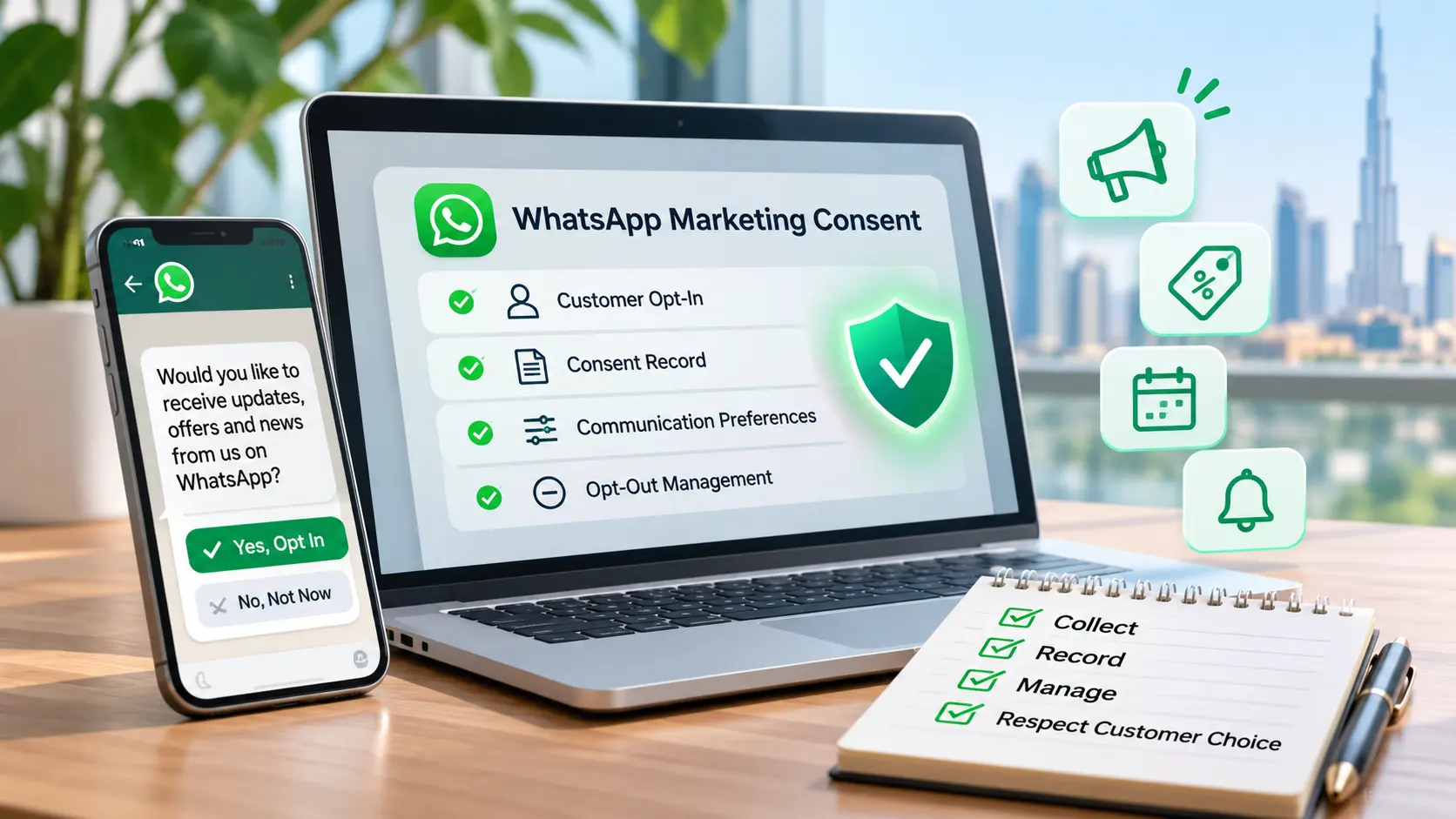
A long list of phone numbers is not the same as a list of customers who agreed to WhatsApp marketing. Reliable consent depends on what customers were told, which business will contact them, what messages they accepted, and whether they can withdraw their choice. This article explains a practical way to collect, document, verify and manage those permissions over time.
What Is WhatsApp Marketing Consent?
WhatsApp marketing consent is a customer’s informed agreement to receive promotional communication from an identified business through WhatsApp. It should describe the kind of content the business intends to send. A telephone number provided for delivery, a quotation or customer support is not automatically permission for future campaigns.
For example, a Dubai customer who requests a property viewing may expect a reply about that viewing. That enquiry alone does not establish permission to receive unrelated monthly property promotions. A separate and clear marketing choice is a safer, more transparent process.
What Does the WhatsApp Business Platform Require?
The WhatsApp Business Messaging Policy states that businesses may contact a person when the person has supplied their mobile number or username and has opted in to subsequent communications. Businesses are responsible for obtaining permissions in a way that meets applicable law and must respect requests to discontinue WhatsApp contact, whether those requests arrive inside or outside WhatsApp.
For the WhatsApp Business Platform, business-initiated conversations require approved message templates. Free-form replies are allowed inside the customer service window, which opens or resets when the customer messages the business and lasts 24 hours. A customer service conversation should not be treated as unlimited permission for later promotional broadcasts.
Meta also expects accurate business identification and appropriate privacy notices. In practice, businesses should explain what they will send and retain evidence of the choice. Keeping separate preferences for marketing and service notifications is a useful record-keeping practice, not a claim that every field in the example below is individually mandated by Meta.
Ways to Collect WhatsApp Marketing Consent
Website forms and landing pages
Place a clearly worded marketing checkbox next to the phone-number field. For example, a quotation form can keep the marketing choice optional and unchecked by default when appropriate. Store the wording shown, the form version, the chosen setting and the submission timestamp. A dedicated landing page can explain the benefit of subscribing without burying the permission in general terms.
Checkout and account registration
A retailer may ask whether a buyer wants WhatsApp promotional updates separately from order information. Completing a purchase should not itself add the buyer to a marketing audience. Make the choice understandable and avoid treating a mandatory checkout field as proof of voluntary promotional consent.
QR codes, events and physical locations
A QR code on an exhibition stand can take visitors to a transparent sign-up page or a WhatsApp conversation that clearly requests opt-in. Merely scanning a poster or exchanging a business card is not sufficient evidence of marketing permission. For in-person registration, staff should record the disclosed wording, date, source and affirmative customer action.
SMS and other existing channels
Businesses can request WhatsApp permission through an existing communication channel when that outreach and the opt-in process are themselves permitted. Keep the invitation distinct from the eventual marketing subscription. Consent for email or SMS does not automatically establish consent for WhatsApp.
Which Information Should a Consent Record Contain?
A useful WhatsApp opt-in record connects the customer, the exact choice and its supporting evidence. The fields below form a recommended operational model; actual legal requirements depend on jurisdiction, industry and processing purposes.
|
Record field |
Why it helps |
|
Contact ID and WhatsApp number |
Identify the individual and prevent duplicate sends |
|
Business or brand name |
Identify which organisation received permission |
|
Permission status and categories |
Show whether marketing is allowed and for which types |
|
Opt-in timestamp and source |
Identify when and where the choice was made |
|
Consent statement and version |
Preserve the disclosure visible at collection |
|
Affirmative action/evidence |
Support an audit of the customer’s decision |
|
Preferred language and last update |
Support correct contact and record changes |
|
Withdrawal timestamp and source |
Prevent further messaging after an opt-out |
For a website signup, keep the form version, event ID and timestamp together. For a physical event, retain an appropriately documented sign-up record. Access should be restricted, and evidence should not be held longer than necessary under the applicable retention policy.
How to Track Consent Across Contact Lists and Systems
Use a central customer record or a reliably synchronized permission register instead of relying on separate spreadsheets owned by individual staff members. Give each contact one current permission status, a record of changes, and any relevant channel or campaign categories. Resolve duplicate numbers before each send.
For example, a marketing team planning a Dubai retail promotion should select contacts who opted in to WhatsApp offers from that specific business, have not opted out, and are suitable for the intended campaign. Contacts that lack reliable proof should be reviewed rather than automatically included.
Sales and customer support employees may need visibility of communication preferences, but only authorized staff should be able to change permissions. Maintain an audit trail where your systems support it. Train employees not to overwrite withdrawal records simply because a customer later makes a service enquiry.
How to Process WhatsApp Opt-Out Requests
Customers can ask to stop communications with messages such as “STOP,” “Unsubscribe,” or ordinary language such as “Please do not message me again.” Staff should interpret the request according to its meaning rather than only looking for an exact keyword. The request could also arrive via phone, email or a website.
- Identify the customer and determine whether the request concerns all WhatsApp contact or a particular message category.
- Immediately block further marketing consistent with the customer’s request; do not wait for the next campaign.
- Update the central status and any connected campaign lists or CRM records.
- Acknowledge the withdrawal briefly if appropriate, without adding another sales message.
- Keep limited evidence needed to honor and demonstrate the withdrawal, subject to retention rules.
- Test that future audience exports and automated sequences exclude the contact.
Removing a person from a single campaign file is not enough if other lists or systems can still send messages. A suppression list or shared opt-out status helps prevent the same contact from being re-imported.
Marketing Consent Is Not the Same as Customer Service
A customer who writes to ask whether a product is available has opened a service conversation; that does not create a general marketing subscription. A business-initiated promotion and a response to a specific customer question serve different purposes and follow different platform messaging rules. Outside the permitted service window, use the appropriate approved template where communication is otherwise authorized.
Order or appointment notifications should relate to the transaction or service the customer expects. Adding unrelated advertising can change the nature of a message. Businesses should classify and submit templates according to the actual message content and current Meta guidance.
Practical Opt-In and Opt-Out Wording
Website marketing checkbox
“I agree to receive WhatsApp marketing messages about products, offers and announcements from [Business Name]. I can ask to stop these messages at any time.”
Promotional subscription invitation
“Would you like [Business Name] to send you relevant offers on WhatsApp? Reply JOIN if you agree, or NO if you do not.” Only use this invitation through a permitted contact channel and retain the reply with the disclosed terms.
Separate service update preference
“I would like to receive WhatsApp updates about my orders, bookings or service requests from [Business Name].” Keep this choice separate where appropriate, and do not assume it covers unrelated advertising.
QR code sign-up explanation
“Scan to open the WhatsApp updates sign-up page. Review the message types and choose whether to subscribe to offers from [Business Name].”
Opt-out acknowledgment
“Your request has been received. We will stop sending WhatsApp marketing messages from [Business Name] in line with your preference.”
These are illustrative wording examples, not universal legal forms or automatically approved Meta message templates. Adapt them to the actual sender, purpose and applicable legal requirements.
A Simple Consent Management Workflow
- Identify the brand and the categories of WhatsApp messages you wish to send.
- Write clear notices and an appropriate affirmative opt-in mechanism.
- Record the customer choice, date, source and version of the displayed wording.
- Store the record securely alongside current contact preferences.
- Validate permission and suppress opted-out contacts before every marketing send.
- Send content consistent with the recorded customer expectations and approved template requirements.
- Monitor replies and promptly process unsubscribe requests across all systems.
- Review duplicate contacts, stale permissions and staff access periodically.
Example: Dubai Retail Business
A Dubai retailer adds a WhatsApp offers checkbox to its website signup. A customer selects it after seeing the business name and an explanation of the messages. The website saves a unique customer ID, the number, the choice, the date and the disclosure version. Before announcing a seasonal collection, the team checks eligible subscribers and excludes all opt-outs.
Later, the customer sends “Please stop offers.” The support agent records the withdrawal, confirms it if appropriate and ensures the central suppression status prevents messages from the next campaign. The customer may still contact the retailer for order assistance without being added back to marketing.
Common Mistakes and Better Alternatives
- Adding every collected number to marketing: require a specific, recorded WhatsApp choice.
- Assuming a past enquiry is consent: keep the purpose of service replies separate from campaigns.
- Hiding the opt-in inside mandatory terms: show a clear, accessible statement and affirmative action.
- Losing the original wording: version consent text and preserve the disclosure evidence.
- Ignoring messages that do not say exactly STOP: process requests according to their meaning.
- Keeping disconnected marketing lists: synchronize withdrawal status and recheck imports.
- Sharing all records with everyone: use role-based access and limit unnecessary data.
How WapiNEXA Fits Into the Process
WapiNEXA publishes capabilities for WhatsApp campaigns, team conversations in a shared inbox and CRM connectivity. These tools can help teams organize communications and manage replies once the business has established an appropriate permission process.
A dedicated WapiNEXA consent registry, timestamped audit trail, automatic opt-out synchronization and consent-based audience filtering have not been independently verified here. Businesses should therefore keep an authoritative consent record in their CRM or other appropriate system and test any connection before using it for live campaigns. The business remains responsible for its marketing permissions.
UAE Privacy Considerations
WhatsApp policy and UAE data-protection law are separate layers of responsibility. The UAE’s federal Personal Data Protection Law establishes requirements for processing personal data and includes rules concerning consent and other lawful bases. Not every UAE business or data processing operation necessarily falls under identical provisions; industry-specific and free-zone frameworks can also matter.
Limit collected personal data to the purpose, protect it from unauthorized access, and document retention and deletion practices. Do not assume one fixed retention period for WhatsApp opt-in evidence. Seek appropriate legal or privacy advice for the business’s particular processing activities.
Frequently Asked Questions
What is WhatsApp marketing consent management?
It is the ongoing process of collecting permission, documenting evidence, checking contact eligibility and recording changes or opt-outs before marketing messages are sent.
Do businesses need permission for WhatsApp marketing?
WhatsApp’s Business Messaging Policy requires appropriate opt-in permission for subsequent business communications. Businesses must also comply with relevant laws and respect withdrawal requests.
Does having a phone number mean a customer opted in?
No. A number provided for delivery, a booking or a quotation does not automatically show agreement to receive unrelated promotional messages.
What should a WhatsApp opt-in record include?
Keep the contact, business identity, permission status, collection date and source, wording shown and evidence of the affirmative choice, plus relevant preference and withdrawal history.
Can a website form collect WhatsApp permission?
Yes, if the disclosure and customer action are appropriate for the business, Meta policy and applicable law. Store the selected preference and the form version used.
How should a company handle opt-outs?
Stop the communication covered by the request, record the withdrawal and update all relevant sending systems so it is not restarted through another list.
Is a customer service enquiry permission for marketing?
No. Responding to an enquiry is different from obtaining permission for future campaigns.
How long must consent records be retained?
There is no single universal period to apply to every business. Follow the relevant legal requirements, evidential needs and documented retention and deletion policy.
Can a CRM track WhatsApp consent?
Yes, if it has the necessary fields, history and access controls. Verify that the CRM and campaign tools share changes reliably; do not assume synchronization.
How should large contact lists be managed?
Use centralized permission status, deduplication, source evidence, category preferences and a suppression process checked before each campaign.
Conclusion
Responsible WhatsApp marketing starts with clear expectations and continues with reliable records. Explain who will message the customer, record what was agreed, check permission before sending and act promptly when preferences change. WapiNEXA can support the surrounding campaign and team communication workflow, while the business maintains control over the validity of its consent records.